
 Dịch
Dịch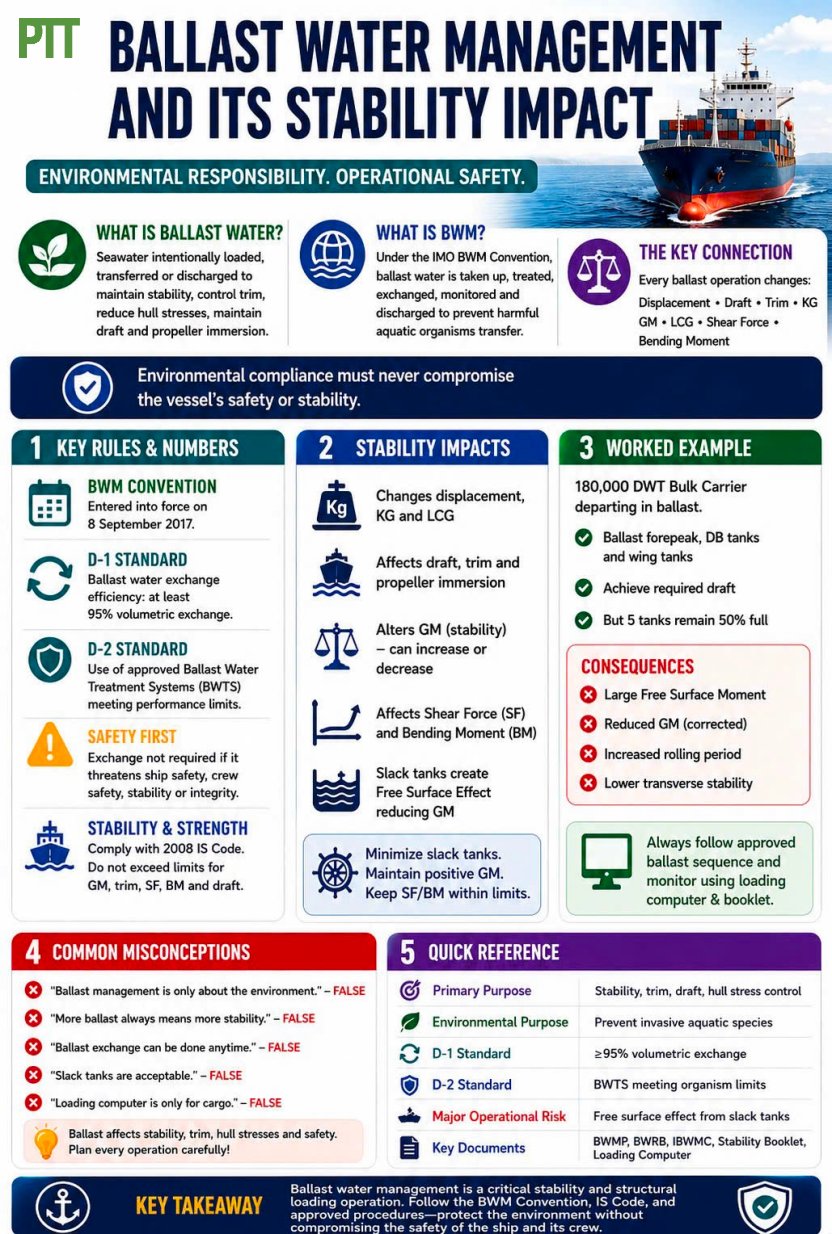
- Ballast Water Management Isn't Just About the Environment—It's About Ship Stability Too.
When most people hear Ballast Water Management (BWM), they immediately think about preventing the spread of invasive marine species.
That's only half the story.
Every ballast operation also changes your ship's stability, trim, draft, hull stresses, and overall structural condition. In other words, every time ballast water is loaded, transferred, or discharged, you're not just complying with an environmental regulation—you're actively changing how the ship behaves at sea.
A common misconception among cadets and even some junior officers is that "more ballast always means more stability." That's not always true.
If several ballast tanks are left partially filled, the resulting free surface effect reduces the ship's corrected GM, increasing the rolling period and reducing transverse stability. Likewise, an incorrect ballast sequence can create excessive trim, increase shear forces and bending moments, or even exceed the structural limits approved in the ship's Loading Manual and Stability Booklet.
This is why ballast operations should never be treated as a routine pump operation.
Before any ballast transfer, officers must verify the condition using the loading computer, ensure compliance with the approved Ballast Water Management Plan (BWMP), monitor GM, trim, shear force, bending moment, and tank restrictions, and minimize slack ballast tanks wherever operationally possible.
Under the IMO Ballast Water Management Convention, ballast exchange or treatment must never compromise the safety of the vessel. If conducting a ballast exchange would endanger the ship, crew, or structural integrity, safety takes precedence.
Today, following the full implementation of the D-2 Ballast Water Performance Standard, Port State Control inspections increasingly focus not only on the proper operation of Ballast Water Treatment Systems (BWTS) and record keeping, but also on whether officers understand safe ballast management procedures.
- Remember: Ballast water management is more than environmental compliance. It is a stability operation, a structural loading operation, and ultimately, a critical ship safety operation.
Have you ever seen ballast operations significantly affect a ship's trim or stability during cargo operations or ballast exchange? Share your experience in the comments.