 Dịch
Dịch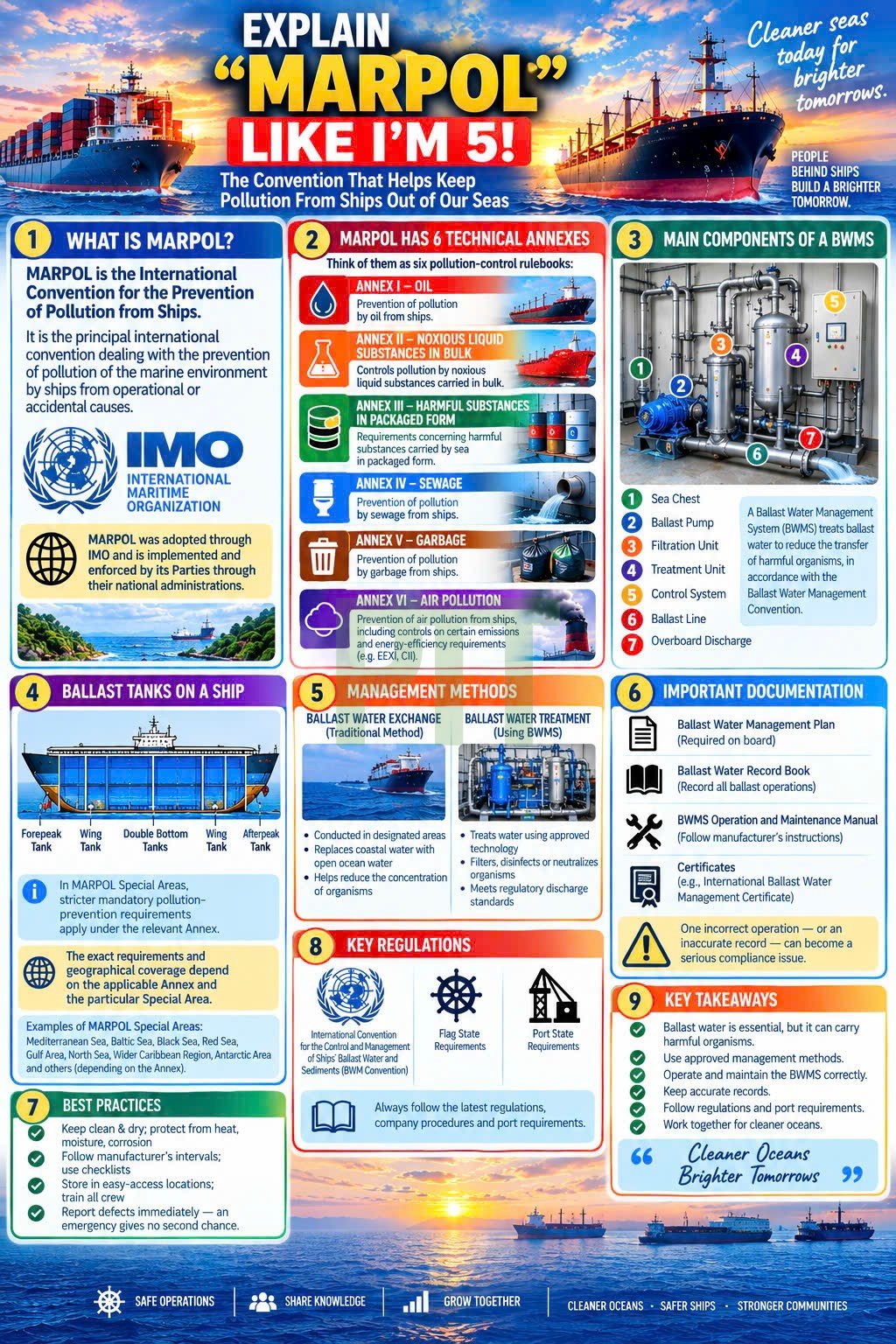

The Convention That Helps Keep Pollution From Ships Out of Our Seas
Imagine the ocean is our home.
Ships operate there every day—but oil, chemicals, sewage, garbage, and air emissions can harm the marine environment if they are not properly controlled.
That’s where MARPOL comes in.
1️⃣ WHAT IS MARPOL?
MARPOL is the International Convention for the Prevention of Pollution from Ships.
It is the principal international convention dealing with prevention of pollution of the marine environment by ships from operational or accidental causes.
It is administered internationally through the IMO.
2️⃣ MARPOL HAS 6 TECHNICAL ANNEXE
Think of them as six pollution-gcontrol rulebooks:
ANNEX I — OIL
Prevention of pollution by oil.
ANNEX II — NOXIOUS LIQUID SUBSTANCES
Controls pollution by noxious liquid substances carried in bulk.
ANNEX III — HARMFUL SUBSTANCES IN PACKAGED FORM
Requirements concerning harmful substances carried by sea in packaged form.
ANNEX IV — SEWAGE
Prevention of pollution by sewage from ships.
ANNEX V — GARBAGE
Prevention of pollution by garbage from ships.
ANNEX VI — AIR POLLUTION
Prevention of air pollution from ships, including controls on certain emissions and energy-efficiency/carbon-intensity requirements.
3️⃣ DOES MARPOL MEAN “NOTHING CAN EVER GO OVERBOARD”?
NO.
MARPOL does not simply say:
“Never discharge anything into the sea.”
Different Annexes contain different prohibitions, conditions, exceptions, distances, equipment requirements and Special Area rules.
️ Always identify which Annex and regulation applies before deciding whether a discharge is permitted.
4️⃣ WHAT ARE “SPECIAL AREAS”?
Some sea areas receive a higher level of protection because of their oceanographic/ecological conditions and shipping traffic.
Within designated MARPOL Special Areas, stricter mandatory pollution-prevention requirements apply under the relevant Annex.
The exact requirements depend on the Annex and the particular Special Area.
5️⃣ WHAT RECORD BOOKS MAY MARPOL REQUIRE?
Depending on the ship and its operations, MARPOL can require records such as:
- Oil Record Book
- Cargo Record Book
- Garbage Record Book
Other MARPOL documentation and records may also apply.
️ Entries must accurately reflect the operation performed—these are official compliance records, not casual notes.
6️⃣ WHY DOES THIS MATTER ONBOARD?
MARPOL compliance involves much more than knowing discharge distances.
It can involve:
- Approved equipment
- Procedures and plans
- Record keeping
- Crew familiarization
- Proper operation and maintenance
- Flag/Port State inspections
- Pollution-prevention practices
One incorrect operation—or an inaccurate record—can become a serious compliance issue.
7️⃣ WHO IS RESPONSIBLE?
Pollution prevention is a shipboard team responsibility.
The Master and officers have specific responsibilities, but every crew member involved in MARPOL-related operations must follow the vessel’s approved procedures and applicable regulations.
REMEMBER
MARPOL is not one single “no discharge” rule.
It is a comprehensive international framework covering several different pollution sources from ships.
IN SHORT
- Annex I → Oil
- Annex II → Noxious liquid substances in bulk
- Annex III → Harmful substances in packaged form
- Annex IV → Sewage
- Annex V → Garbage
- Annex VI → Air pollution
Know the Annex. Know the procedure. Protect the sea.
PTT - Safety • Knowledge • Cleaner Seas
#PTT
#MARPOL
#MarinePollutionPrevention
#MaritimeEducation
#Seafarers
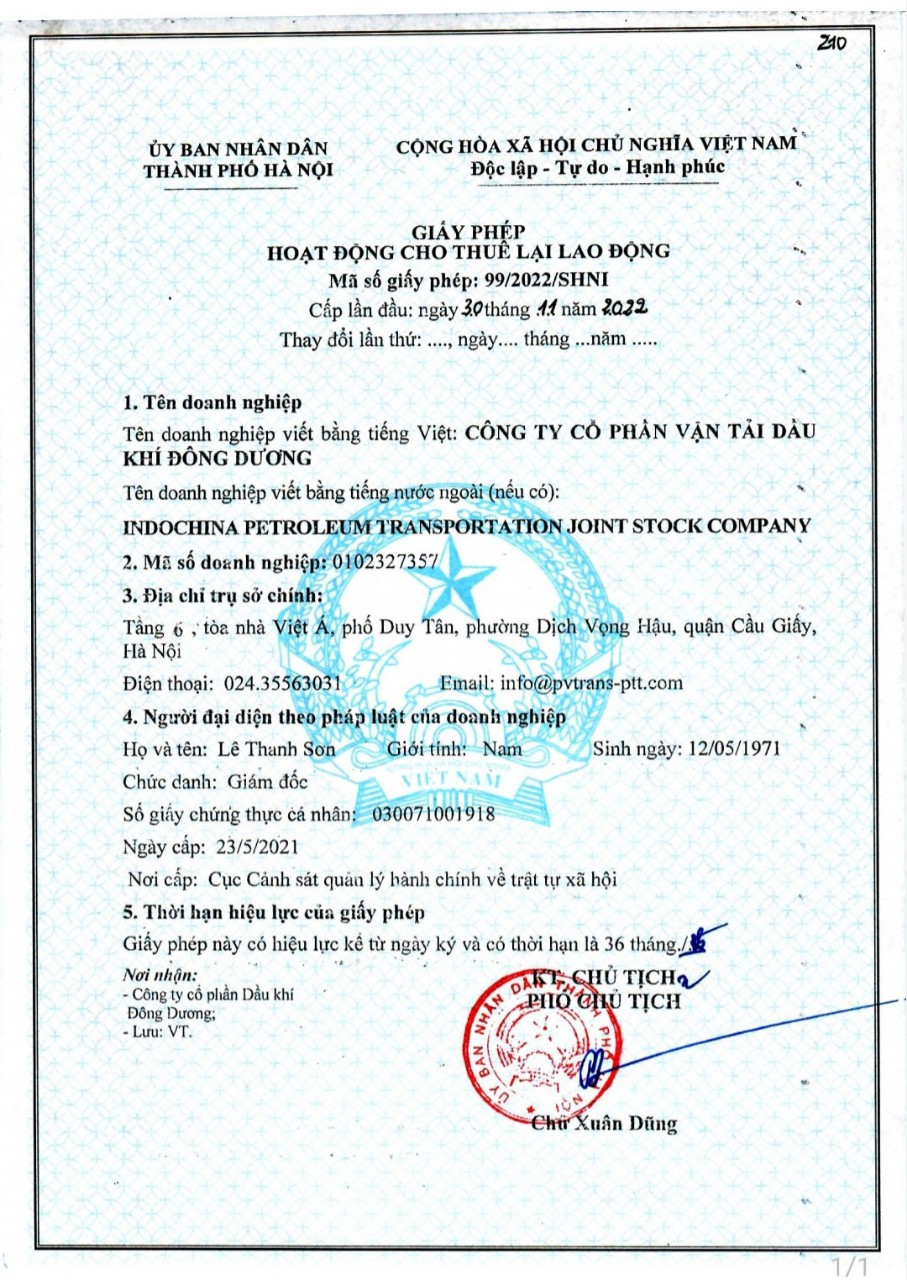
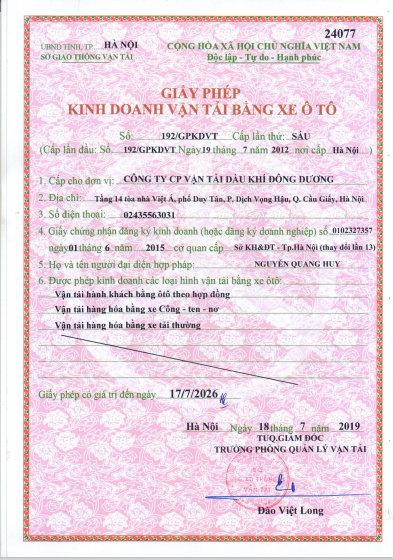
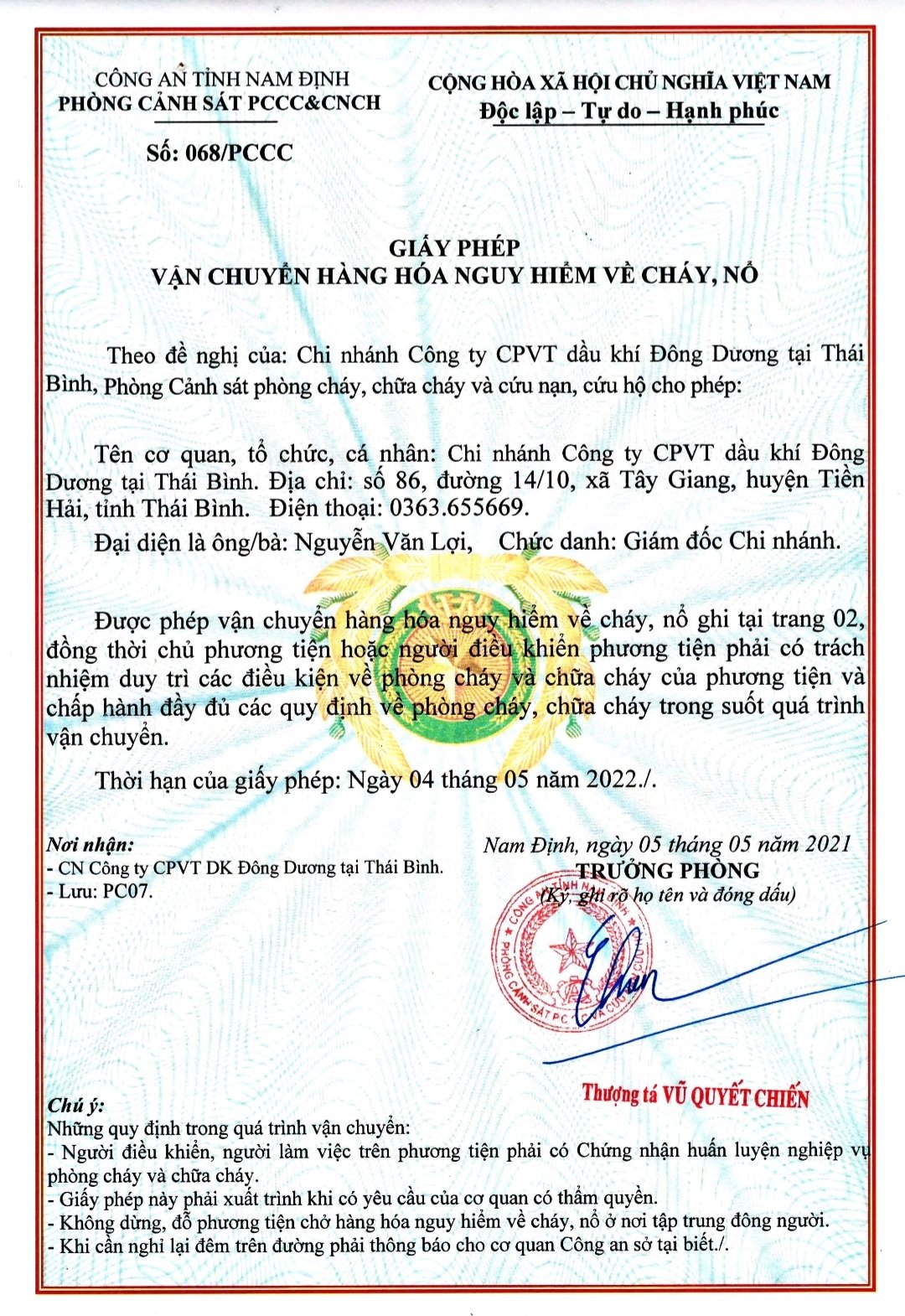
CÔNG TY CỔ PHẦN VẬN TẢI DẦU KHÍ ĐÔNG DƯƠNG (PVTrans - PTT)
#PVTransPTT #TriThucThuyenVien #MaritimeKnowledge #Seafarers