 Dịch
Dịch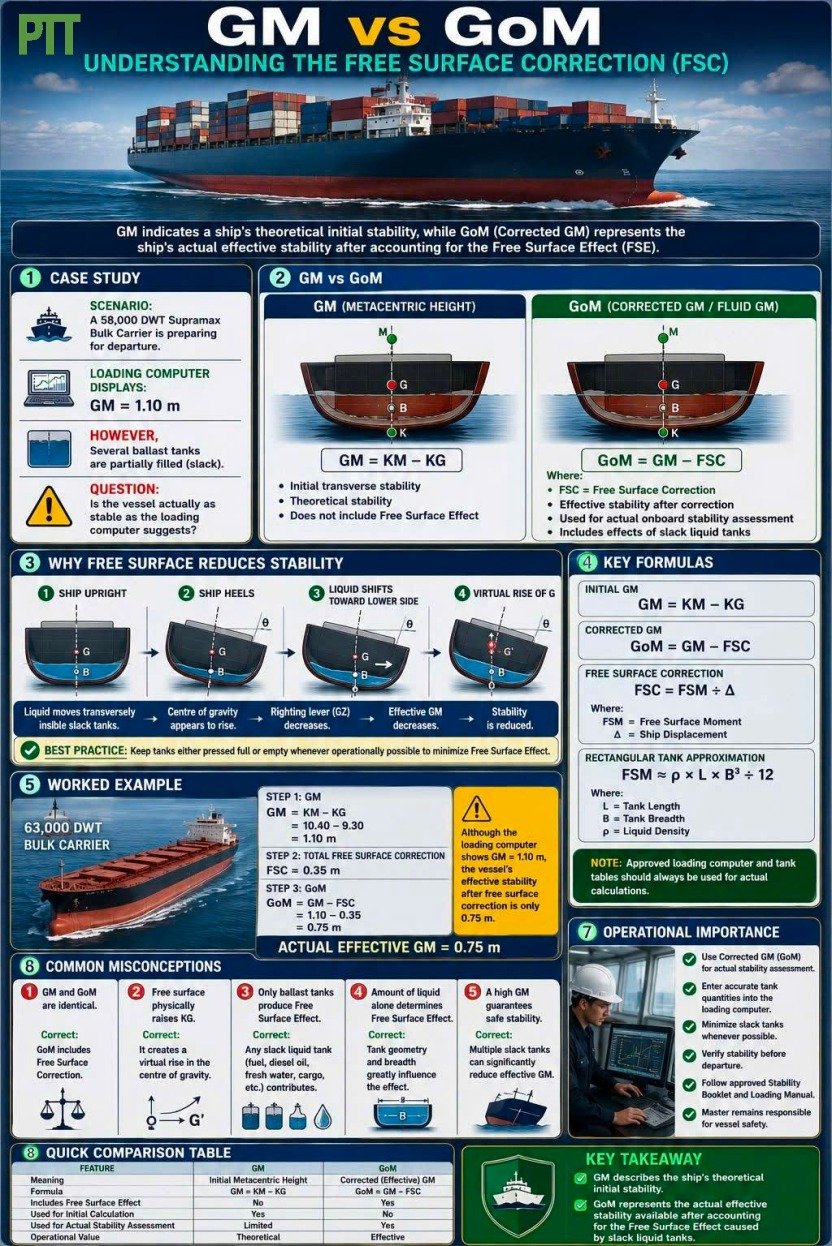
A ship may appear stable on the loading computer, but slack tanks can significantly reduce its actual stability. Understanding the difference between GM (Metacentric Height) and GoM (Corrected GM) is essential for every deck officer and marine engineer.
What's the Difference?
- GM (Metacentric Height)
- Theoretical initial stability of the vessel.
- Calculated before considering Free Surface Effect (FSE).
- Formula: GM = KM − KG
- GoM (Corrected GM)
- Actual effective stability after applying Free Surface Correction (FSC).
- Used for operational stability assessment.
- Formula: GoM = GM − FSC
- Why Does Free Surface Effect Reduce Stability?
- Liquid in partially filled tanks moves as the ship heels.
- The shifting liquid creates a virtual rise in the ship's center of gravity (G).
- This reduces the righting lever (GZ) and lowers effective GM.
- The result is reduced stability and an increased risk of excessive heel or capsize.
- Best Practices
- Keep tanks either pressed full or empty whenever operationally possible.
- Minimize the number of slack tanks.
- Enter accurate tank quantities into the loading computer.
- Always verify Corrected GM (GoM) before departure.
- Follow the approved Stability Booklet, Loading Manual, and company procedures.
Key Takeaway GM tells you the ship's theoretical stability. GoM tells you the stability you actually have after accounting for Free Surface Effect. Understanding this difference is critical for safe cargo operations and voyage planning.
#MerchantNavy #ShipStability #GM #GoM