
 Dịch
Dịch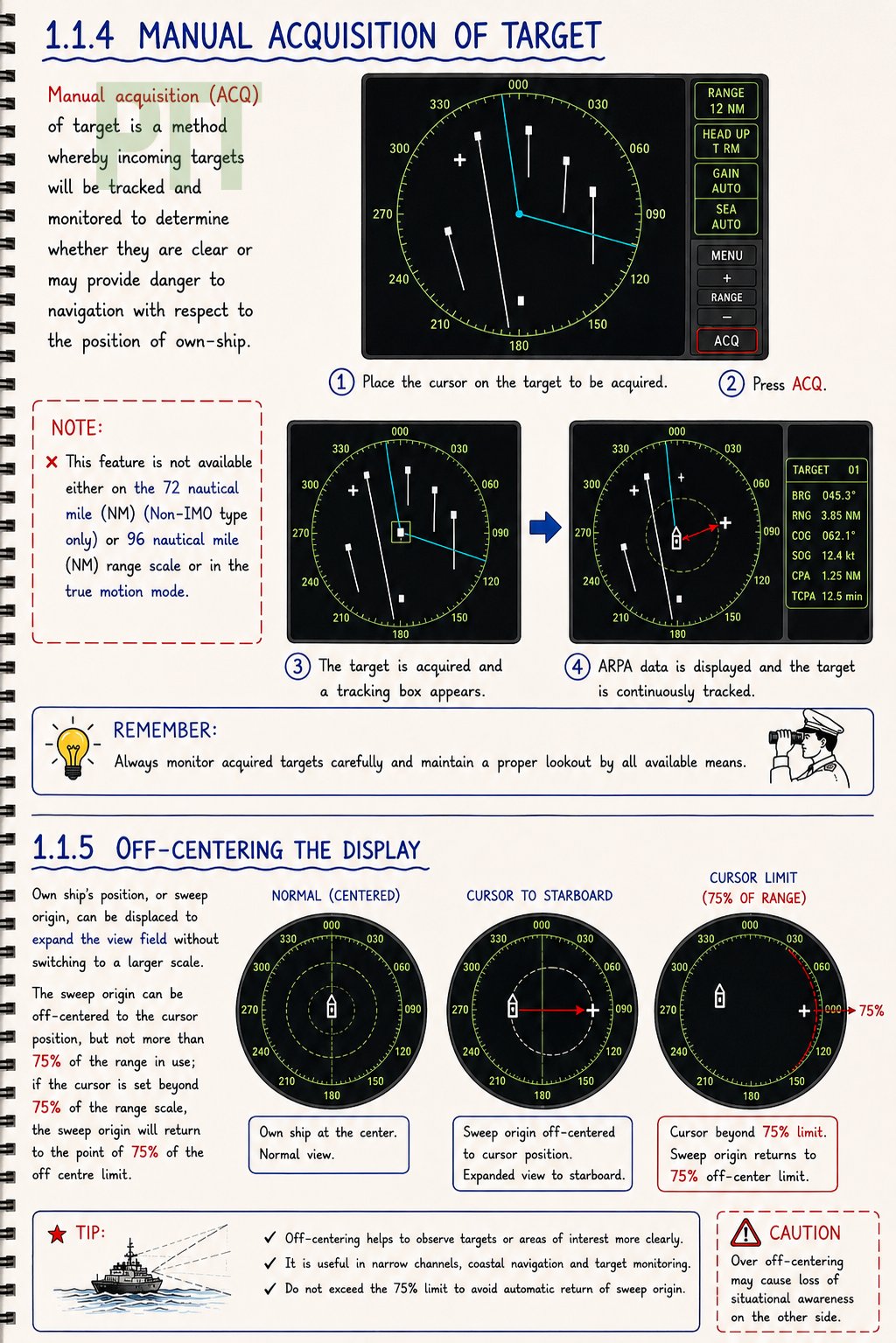
📡 RADAR/ARPA: MANUAL TARGET ACQUISITION & OFF-CENTERING
Correct use of ARPA controls helps the Officer of the Watch monitor traffic and detect developing collision risks—but the displayed information must always be checked carefully.
Manual target acquisition — ACQ
Manual acquisition allows the operator to select a radar echo for ARPA tracking.
Typical procedure:
1️⃣ Confirm that the echo represents a genuine target.
2️⃣ Place the cursor accurately over the target.
3️⃣ Press the ACQ control.
4️⃣ Confirm that the acquisition or tracking symbol appears.
5️⃣ Allow sufficient time for the ARPA solution to stabilise.
6️⃣ Monitor the target continuously and verify the data against the raw radar echo.
Once reliable tracking is established, ARPA may display:
Bearing and range.
Course and speed.
True or relative vector.
Closest Point of Approach — CPA.
Time to Closest Point of Approach — TCPA.
- ️ CPA and TCPA should not be accepted blindly. They may change when own ship or the target alters course or speed, when sensor inputs are inaccurate, or when tracking quality is poor.
Off-centering the radar display
Off-centering moves own ship away from the display centre, providing more viewing space in the direction of interest without immediately selecting a larger range scale.
It can be useful for:
- Coastal navigation.
- Narrow channels.
- Monitoring traffic ahead.
- Observing a developing close-quarters situation.
However, excessive off-centering reduces the visible area on the opposite side and can weaken overall situational awareness.
- ️ The illustrated 75% limit and the unavailable range scales are equipment-specific examples. Actual limits and operating restrictions vary by radar model—always follow the manufacturer’s manual.
Remember
Maintain a proper lookout by sight, hearing and all available means.
Check acquired targets against the raw radar picture.
Monitor for target swap, lost targets and unstable vectors.
Use suitable range scales and display orientation.
Do not rely on ARPA as the sole method of determining collision risk.