
 Dịch
Dịch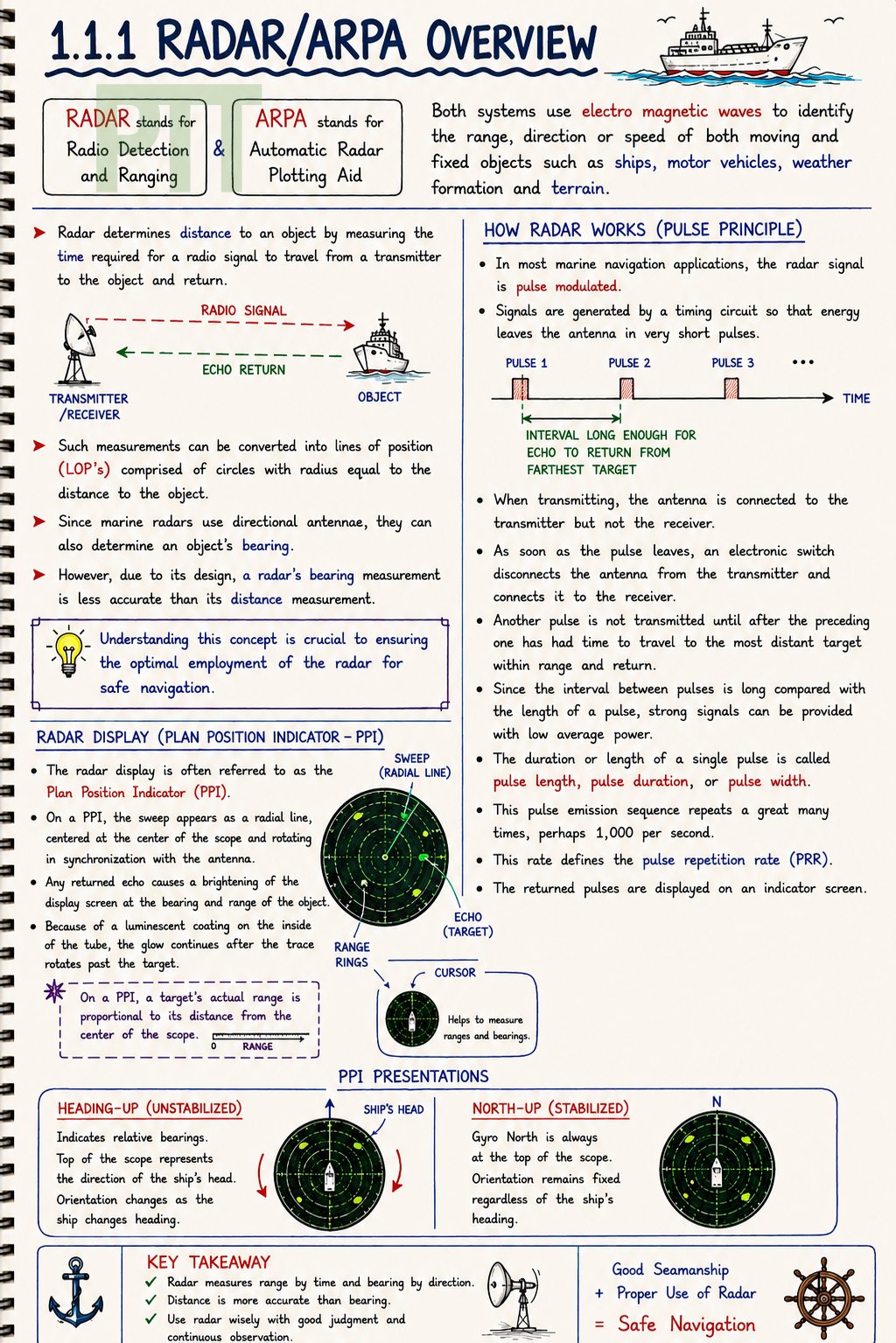
📡 RADAR / ARPA OVERVIEW
Radar and ARPA are essential bridge systems—but safe navigation still depends on understanding how they work and recognising their limitations.
- RADAR: Radio Detection and Ranging
- ARPA: Automatic Radar Plotting Aid
How marine radar works
Radar transmits short pulses of electromagnetic energy. When a pulse strikes a target, part of its energy returns to the antenna as an echo.
The equipment uses:
- Echo-return time to calculate the target’s range.
- Antenna direction to determine its bearing.
- Repeated observations to monitor target movement.
Range measurement is generally more accurate than bearing measurement, making correct radar setup and careful observation essential.
Pulse principle
Each transmitted pulse is followed by an interval long enough for echoes from targets within the selected range to return.
Important terms include:
Pulse Length: duration of each transmitted pulse.
Pulse Repetition Rate (PRR): number of pulses transmitted per unit of time.
Echo: the returned signal displayed as a target.
Plan Position Indicator — PPI
The PPI presents radar information around the vessel at the centre of the display.
It shows:
- Target range.
- Target bearing.
- Range rings and cursor information.
- Relative position around own ship.
Common display orientations
🧭 Heading-Up — Unstabilised
The top of the display represents the vessel’s heading. The presentation rotates as the vessel’s heading changes.
🌐 North-Up — Stabilised
True or gyro north remains at the top of the display while the vessel’s heading symbol moves.
- ️ Radar and ARPA are navigational aids. They do not replace a proper lookout, systematic observation, correct plotting or the use of all available means to assess collision risk.
Good seamanship + correct radar use + continuous observation = safer navigation.