
 Dịch
Dịch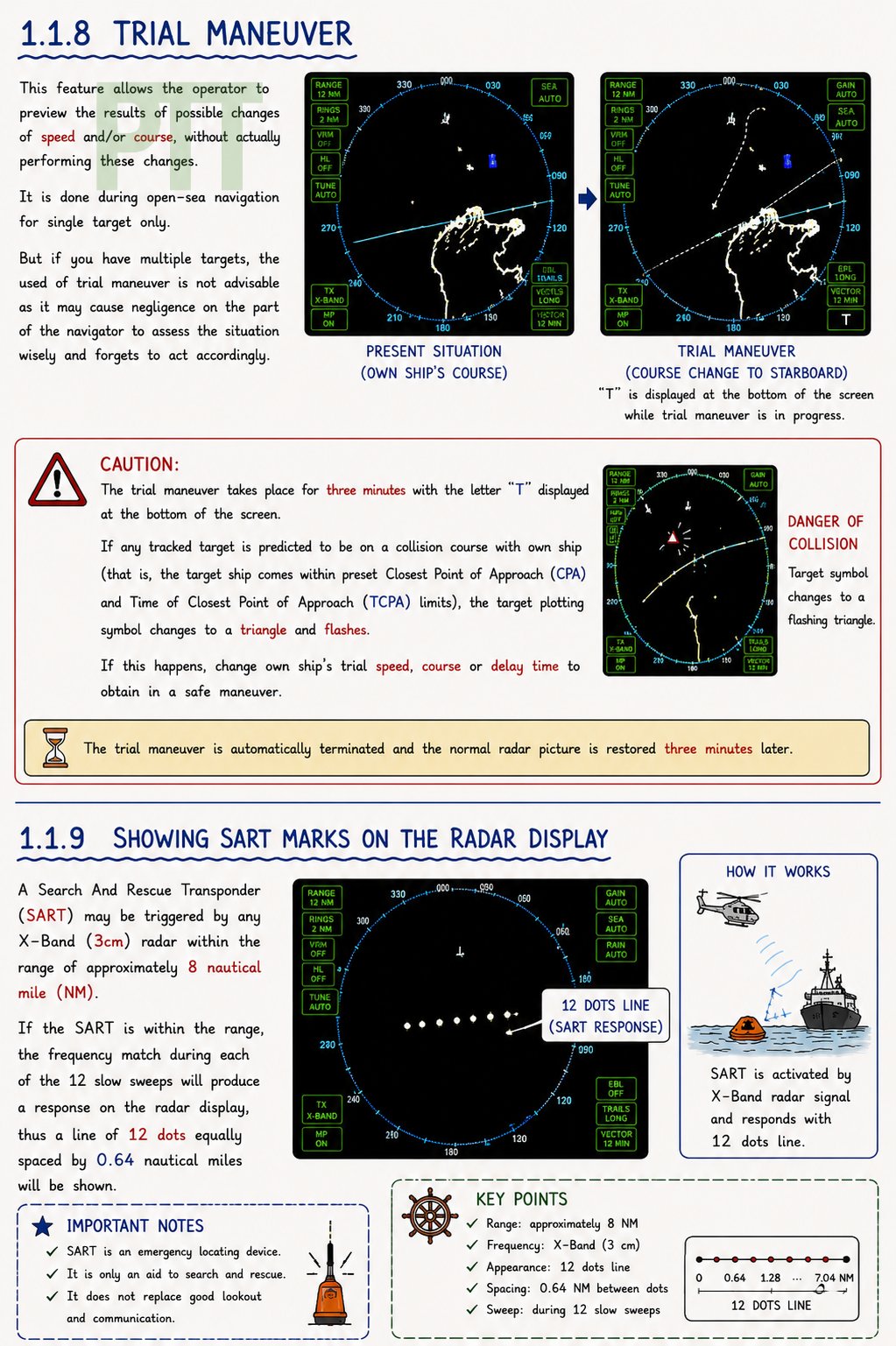
📡 RADAR/ARPA: TRIAL MANOEUVRE & SART RESPONSE
Two important radar functions every Officer of the Watch should understand: using the ARPA trial manoeuvre and recognising a Search and Rescue Transponder on the radar display.
Trial Manoeuvre
The trial-manoeuvre function allows the OOW to simulate a proposed alteration of course, speed or both—without actually manoeuvring the vessel.
It helps assess:
- The predicted effect on tracked targets.
- Changes in CPA and TCPA.
- Whether the proposed action may create a new close-quarters situation.
- Alternative courses or speeds before executing the manoeuvre.
Safe use
1️⃣ Confirm that ARPA tracking and sensor inputs are reliable.
2️⃣ Enter the proposed course, speed and any delay time.
3️⃣ Review the predicted target vectors and CPA/TCPA values.
4️⃣ Check every relevant target—not only the most obvious threat.
5️⃣ Return to the live radar presentation before acting.
6️⃣ If the manoeuvre is safe, act early and substantially, then monitor its effectiveness.
- ️ Trial manoeuvre is only a decision-support tool. Predictions depend on targets maintaining their present course and speed. They can become unreliable if own ship or another vessel manoeuvres.
The displayed “T” symbol, simulation duration and operating method vary between radar models. Follow the manufacturer’s instructions.
Recognising a SART
A Search and Rescue Transponder—SART—is an emergency locating device that responds when interrogated by a compatible X-band 3 cm radar.
A SART response normally appears as:
🔸 A line of up to 12 equally spaced dots extending outward from the SART’s position.
🔸 Approximately 0.6 nautical miles between successive dots.
🔸 At closer range, the dots may develop into arcs and eventually concentric circles.
The commonly quoted detection range of about 8 NM is approximate. Actual range depends on radar and SART antenna heights, sea state, weather and equipment performance.
If SART marks appear
- Report immediately to the Master.
- Mark the bearing and monitor the pattern.
- Use an appropriate range scale.
- Reduce sea and rain clutter carefully without losing the response.
- Inform the relevant rescue-coordination authority.
- Maintain a proper lookout and use all available locating methods.
A SART assists search and rescue—it does not replace visual lookout, communications or coordinated rescue procedures.