
 Dịch
Dịch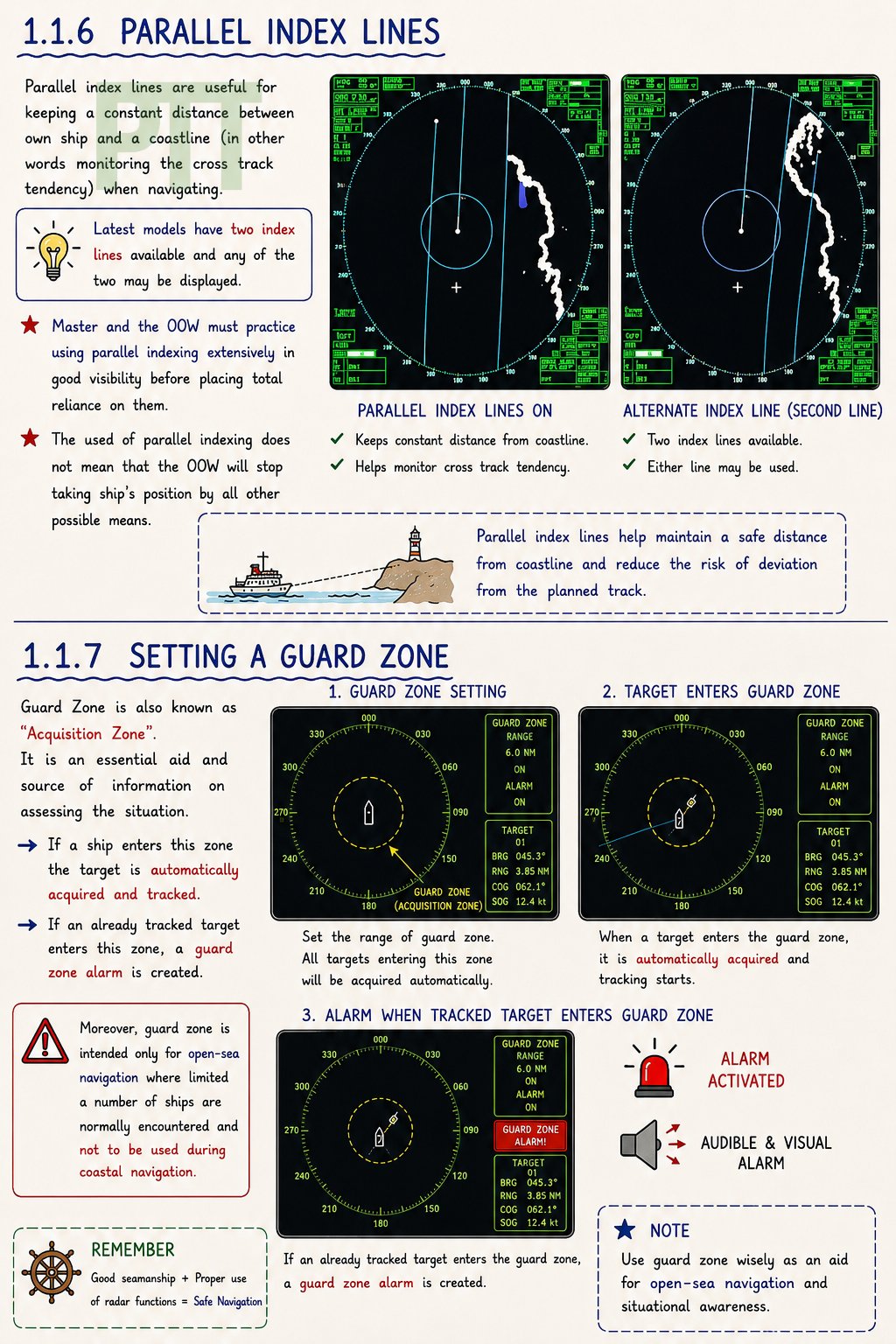
📡 RADAR TECHNIQUES: PARALLEL INDEXING & GUARD ZONES
Parallel index lines and guard zones can significantly improve situational awareness—but only when they are correctly set, continuously monitored and supported by other navigational methods.
Parallel Index Lines — PI
Parallel indexing provides a quick visual method of monitoring the vessel’s position relative to a planned track or charted feature.
It can help the OOW:
- Maintain a planned passing distance from a coastline or hazard.
- Detect cross-track tendency early.
- Monitor progress through channels and confined waters.
- Confirm whether the vessel is moving toward or away from danger.
- Support execution of the passage plan.
The index line should be prepared from the passage plan and positioned using a suitable fixed radar-conspicuous object.
- ️ Parallel indexing does not provide an independent position fix. Continue fixing the vessel’s position using all appropriate available means, and practise the technique in safe conditions before relying on it during critical navigation.
Guard Zone / Target Alarm Zone
A guard zone is a selected area on the radar display used to alert the bridge team when a detected target enters—or is detected within—the defined zone.
Depending on the radar/ARPA model and selected mode, the system may:
Generate an audible and visual alarm.
Highlight the detected echo.
Automatically acquire the target when auto-acquisition is enabled.
Continue tracking a previously acquired target.
Good guard-zone practice
- Select a range and sector appropriate to the traffic situation.
- Avoid placing the zone over land, buoys or persistent clutter.
- Adjust gain, sea clutter and rain clutter correctly.
- Confirm alarms are enabled and audible.
- Investigate every alarm before acknowledging it.
- Monitor targets outside the zone as well as inside it.
- Never use the guard zone as a replacement for a proper lookout.
- ️ Guard-zone behaviour, automatic acquisition, number of index lines and operating limits vary between manufacturers. Always follow the equipment manual and the vessel’s procedures.
Guard zones are not restricted exclusively to open-sea navigation. They may be useful in different situations, but coastal clutter and dense traffic can produce frequent alarms and reduce their effectiveness.
Good seamanship + correct radar setup + continuous observation = safer navigation