
 Dịch
Dịch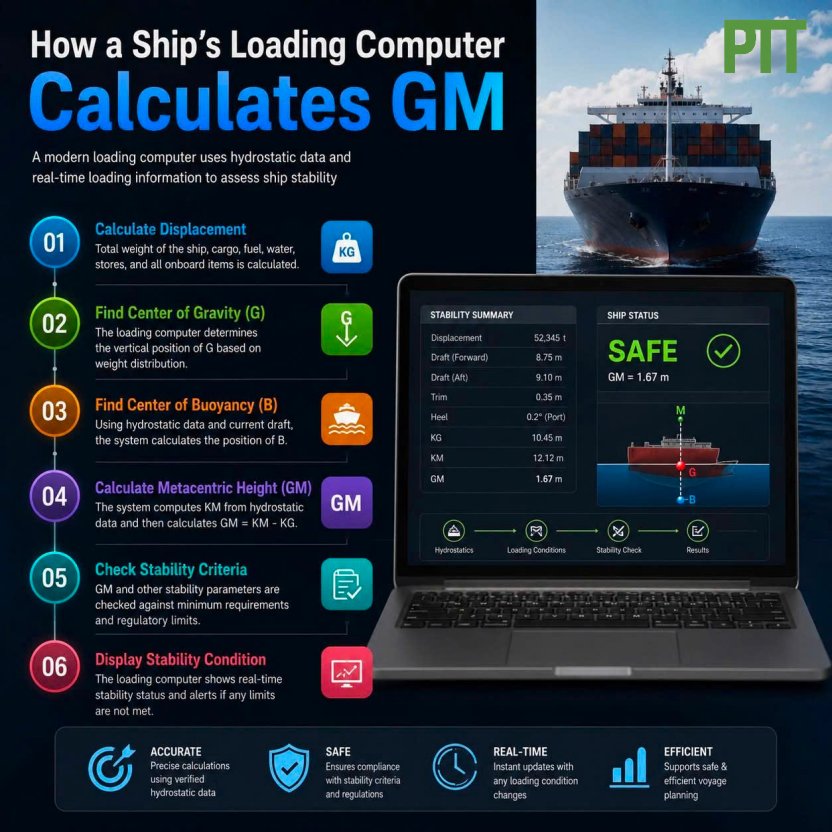
- How Does a Ship's Loading Computer Calculate GM?
A ship's loading computer does far more than display numbers—it continuously evaluates the vessel's stability using hydrostatic data and the current loading condition.
Here's the basic process:
- 1. Calculate Displacement
The system determines the ship's total weight, including cargo, fuel, ballast, freshwater, stores, and other onboard loads.
- 2. Determine the Center of Gravity (G)
Based on how weight is distributed throughout the vessel, the loading computer calculates the position of the center of gravity.
- 3. Calculate the Center of Buoyancy (B)
Using the vessel's draft and hydrostatic data, the system determines the center of buoyancy, the point where buoyant force acts.
- 4. Compute Metacentric Height (GM)
The loading computer calculates GM = KM − KG, providing a key indicator of the ship's initial stability.
- 5. Verify Stability Limits
It automatically checks compliance with operational limits, including GM, draft, trim, heel, shear force, and bending moment.
- 6. Display Real-Time Stability Status
Officers receive instant stability information, helping ensure safe cargo operations and voyage planning.
A well-managed GM contributes to a vessel that is safe, efficient, and compliant with international stability requirements. While a positive GM generally indicates adequate initial stability, the optimal value depends on the ship type, loading condition, and applicable regulations.
- Did you know? Modern loading computers can recalculate a ship's stability within seconds whenever cargo, ballast, or fuel quantities change.