 Dịch
Dịch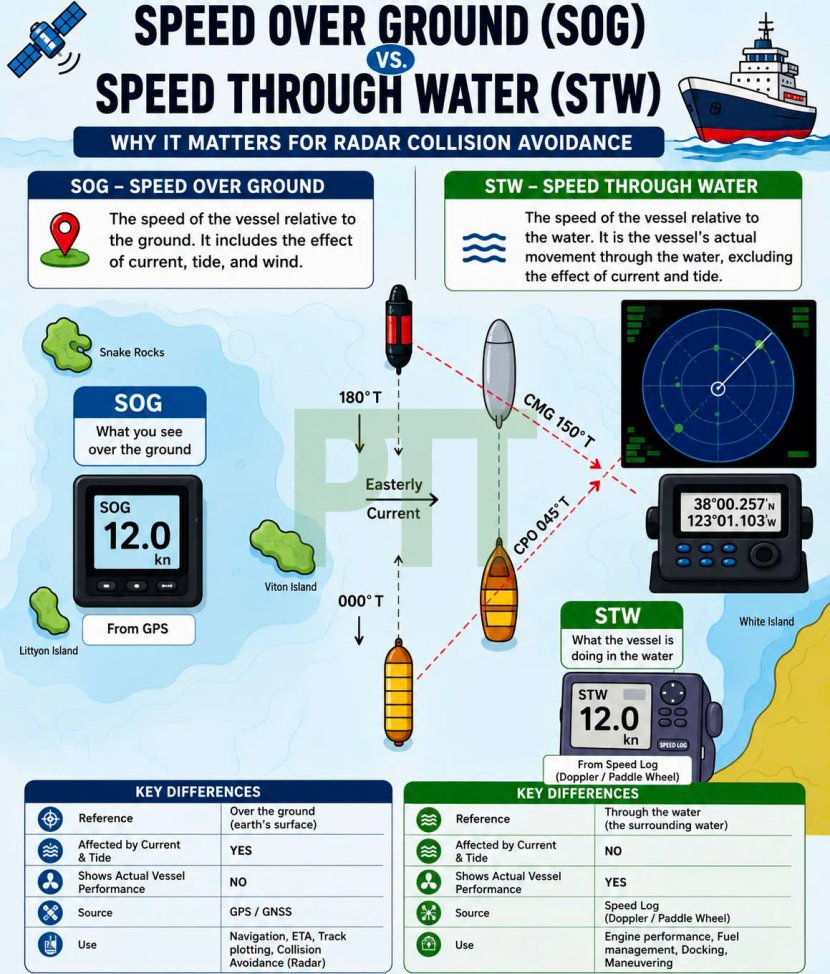
Speed Over Ground (SOG) vs. Speed Through Water (STW)- Basic Things To Know ✅⚓️
Speed Over Ground (SOG) is the vessel’s actual speed relative to the Earth’s surface. It is measured using GPS/GNSS and is affected by currents, tides, and wind. SOG is essential for voyage planning, estimating arrival time (ETA), track monitoring, and radar collision avoidance because it reflects the ship’s true movement over the ground.
Speed Through Water (STW) is the vessel’s speed relative to the surrounding water. It is measured by the speed log (Doppler or electromagnetic log) and is not directly affected by current. STW represents the ship’s actual performance through the water and is important for engine efficiency, fuel management, maneuvering, and docking operations.
Why It Matters for Radar Collision Avoidance
When using ARPA radar, selecting the correct speed input is crucial for accurate CPA (Closest Point of Approach) and TCPA (Time to Closest Point of Approach) calculations. In areas with strong currents, relying only on STW may produce inaccurate target predictions. Using SOG provides a more accurate representation of the vessel’s actual movement over the seabed, improving collision avoidance decisions.
Key Difference
- SOG: Speed over the ground; includes the effect of current.
- STW: Speed through the water; shows the vessel’s true performance.
- Best Practice: Monitor both SOG and STW to understand the effect of current and ensure safe and efficient navigation.