 Dịch
Dịch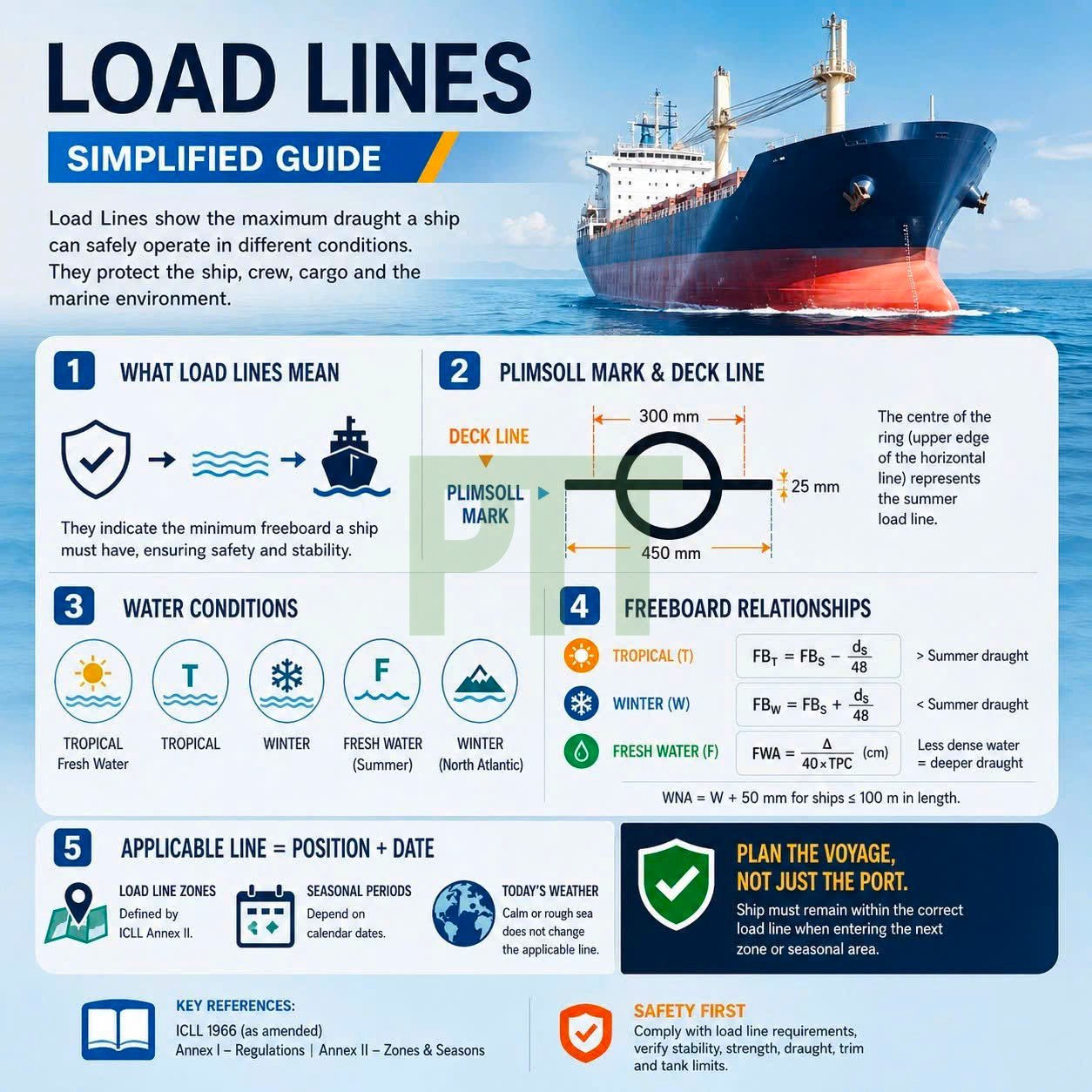

Load lines, commonly known as the Plimsoll Mark, are among the most important safety markings found on a ship's hull. Contrary to popular belief, they are not simply maximum draught marks. Instead, they indicate the minimum freeboard a vessel must maintain under specific operating conditions, ensuring sufficient reserve buoyancy, structural strength, and overall stability.
The applicable load line depends on several factors, including:
Water density (salt water vs. fresh water)
️ Seasonal conditions (Summer, Tropical, Winter)
Geographical load line zones
Seasonal dates defined by international regulations
The Plimsoll System includes different marks such as:
• TF – Tropical Fresh Water
• F – Fresh Water
• T – Tropical
• S – Summer (reference line)
• W – Winter
• WNA – Winter North Atlantic
These markings ensure that a vessel carries a safe amount of cargo while maintaining enough freeboard to withstand changing weather and sea conditions. For example, ships are permitted a deeper draught in tropical waters but must maintain greater freeboard in winter conditions, where rough seas present higher risks.
It is also important to remember that compliance with load lines alone does not guarantee complete safety. Masters and officers must also verify vessel stability, hull strength, trim, stress limits, tank loading, and all other operational requirements before departure.
Understanding the Plimsoll System is fundamental knowledge for every seafarer, naval architect, marine surveyor, and maritime professional because safe loading is the foundation of safe navigation.
Safe loading protects the ship. Safe planning protects the voyage.
#Maritime #LoadLine #PlimsollMark #Freeboard #ShipSafety #MarineEngineering #MerchantNavy #DeckOfficer #Navigation #NauticalScience #MarineSurveyor #CargoOperations #ShippingIndustry #SOLAS #ICLL #Seafarers #PortOperations #MarineEducation #SafetyAtSea #ShipManagement