
 Dịch
Dịch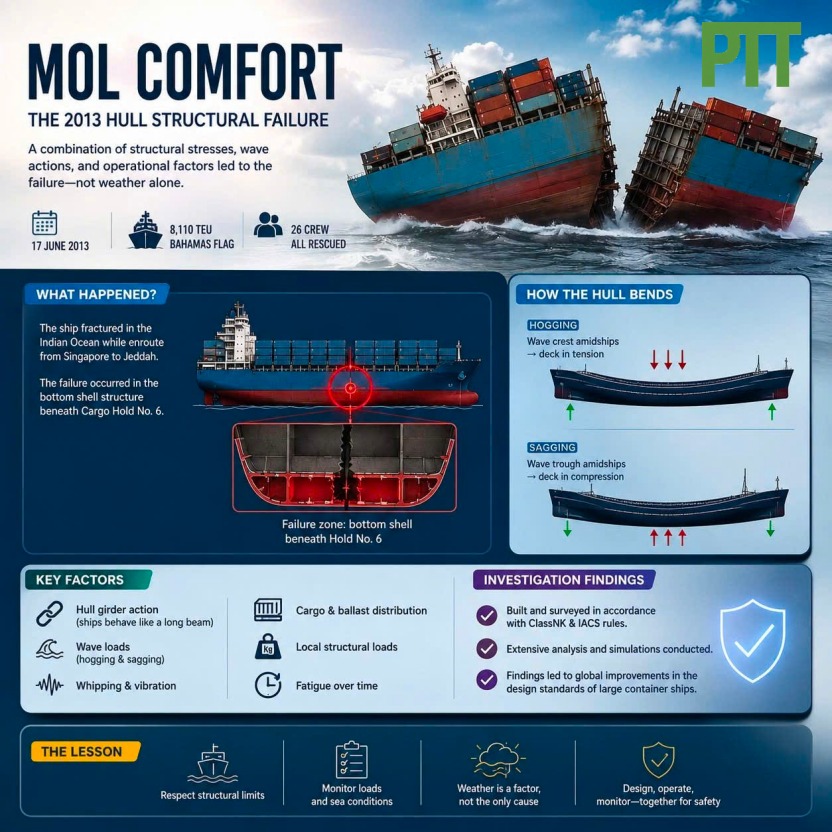
At first glance, many people assumed that bad weather alone caused the loss of the MOL Comfort. However, the official investigation revealed a far more complex engineering story.
The failure resulted from a combination of factors, including:
Hull girder bending under heavy seas
Hogging and sagging stresses
Wave-induced whipping loads
Cargo and ballast distribution
Long-term structural fatigue
Investigators found that the structural failure most likely initiated in the bottom shell structure beneath Cargo Hold No. 6, before progressing into a catastrophic hull fracture.
Although the ship was lost, all 26 crew members were successfully rescued, making it a remarkable example of effective emergency response despite the severe structural failure.
Key Takeaways
Large ships behave like giant floating beams and continuously flex in the ocean.
Heavy seas increase structural loads but are rarely the sole cause of failure.
Proper cargo loading, ballast management, and structural monitoring are essential for safety.
Engineering investigations like this help improve future ship designs and international safety standards.
Every major maritime accident leaves behind valuable lessons that make tomorrow's ships stronger and safer.
What do you think was the biggest contributing factor: heavy seas, structural fatigue, cargo loading, or a combination of all of them? Share your thoughts below!
#Maritime #Shipping #ContainerShip #NavalArchitecture #MarineEngineering #ShipSafety #StructuralEngineering #OceanEngineering #MOLComfort #MaritimeHistory #Seafarers #MarineEducation #ShipDesign #STEM #Engineering